
Entering the world of Canadian real estate investment is an exciting milestone, but many investors quickly realize that the rules of the game shift significantly once they move beyond single-family homes. Not all properties qualify for standard residential financing, and that is exactly where commercial mortgages come into play.
Whether you are an aspiring landlord looking at a 12-unit apartment building or a business owner tired of paying rent for your storefront, understanding property eligibility is the cornerstone of a successful acquisition. Navigating the nuances of commercial real estate financing in Canada can be the difference between securing a high-leverage loan and seeing a deal fall through due to a technicality.
If you are unsure which properties fall under the “commercial” umbrella or how lenders view different asset classes, you aren’t alone. This guide breaks down the essential properties eligible for commercial mortgages to help you maximize your returns and secure the right funding.
Ready to dive in? Speak with a commercial mortgage expert at Mortgage Intelligence to explore your unique options today.
What Is a Commercial Mortgage?
At its core, a commercial mortgage in Canada is a loan secured by real estate that is used for business purposes or to generate income, rather than serving as a primary private residence.
While residential mortgages focus heavily on the borrower’s personal credit score and employment income, commercial lending focuses on the property’s ability to generate cash flow. Lenders want to see that the “Net Operating Income” (NOI) is sufficient to cover the debt obligations.
Key Differences from Residential Mortgages
- Borrower Entity: Commercial loans are often held by corporations or holding companies rather than individuals.
- Loan Terms: While residential loans often have 25 or 30-year amortizations, commercial terms are more flexible but often come with shorter “terms” (e.g., 5 or 10 years) before renewal.
- Valuation: The value of the property is determined by its income potential rather than just comparable sales in the neighbourhood.
For a deeper dive into these distinctions, check out our guide on the differences between personal and investment property mortgages.
Main Categories of Properties Eligible for Commercial Mortgages
The Canadian lending landscape categorizes properties based on their risk profile and usage. Here are the primary types of commercial properties in Canada that qualify for commercial financing.
1. Multi-Unit Residential Properties (5+ Units)
In Canada, the magic number is five. Any residential building with four units or fewer typically falls under residential lending guidelines. However, once a property hits five units or more, it is classified as commercial.
- Examples: Apartment buildings, large townhome complexes, and student housing.
- Why They Qualify: They are purely income-producing property mortgages. Lenders view these as businesses where the “product” is housing.
- Financing Tip: These properties are eligible for CMHC-insured commercial financing, which can offer lower interest rates and higher leverage.
Explore more about investment property mortgage solutions for multi-unit builds.
2. Mixed-Use Properties
A staple of Canadian urban landscapes, mixed-use properties combine residential and commercial spaces. A common example is a “main street” building with a retail shop on the ground floor and two or three apartments above.
- Key Considerations: Lenders look at the percentage of square footage dedicated to commercial use. If the commercial component is too high, it may not qualify for residential-style rates.
- Income Distribution: Lenders evaluate the stability of both the commercial tenant (the shop) and the residential tenants.
3. Retail Properties
Retail financing covers everything from a standalone “Big Box” store to a sprawling suburban shopping plaza.
- What Lenders Look For:
- Tenant Stability: Are the tenants “anchor” stores (like a major grocery chain) or local boutiques?
- Foot Traffic: Location is everything. High-visibility areas command better loan terms.
- Lease Terms: Longer leases (5-10 years) provide the security lenders crave.
4. Office Buildings
From small professional suites for doctors and lawyers to massive glass-clad corporate towers, office buildings are a core part of commercial lending in Canadian real estate.
- Financing Considerations: Lenders are particularly sensitive to office-sector vacancy rates. A building with a single tenant is considered higher risk than a multi-tenant building, as one departure could lead to 100% vacancy.
5. Industrial Properties
Industrial real estate has become one of the most sought-after asset classes in Canada, driven by the rise of e-commerce and the need for logistics hubs.
- Types: Warehouses, manufacturing facilities, and distribution centers.
- Why Investors Choose Them: Industrial tenants often sign “Triple Net” (NNN) leases, meaning the tenant pays for taxes, insurance, and maintenance, making it a low-hassle investment property commercial mortgage.
6. Hospitality Properties
Hotels, motels, and resorts fall under a specialized branch of commercial lending.
- Challenges: These are “operationally intensive.” Unlike an apartment building where tenants stay for years, a hotel “re-rents” its rooms every night.
- Risk Profile: Because income is seasonal and tied to the economy, hospitality loans often require higher down payments and more experienced operators.
7. Special Purpose Properties
These are properties designed for a specific use that would be difficult to convert for another purpose.
- Examples: Self-storage facilities, car washes, gas stations, churches, and private schools.
- Financing Complexity: Because the resale market is limited, specialized lenders or alternative lending options are often required.
Properties That May Not Qualify for Commercial Mortgages
It is equally important to know what doesn’t fit. Generally, the following do not qualify for commercial rates:
- Owner-Occupied Residential: Standard 1-4 unit homes where you live.
- Small Rental Properties: A duplex or triplex is usually handled by residential investment divisions.
- Non-Income-Generating Land: Raw land with no development plan or “pro-forma” (income projection) is often difficult to finance through traditional commercial channels.
Key Factors That Determine Eligibility
When you apply for commercial real estate financing in Canada, the lender isn’t just looking at the building; they are looking at the math.
Income Potential
The Debt Service Coverage Ratio (DSCR) is the most important indicator. Lenders want to see that the property’s income can cover the mortgage payments plus a “buffer” (usually 1.2x to 1.25x the debt).
Property Type and Usage
A warehouse in an industrial park is seen as “safer” than a specialized chemical processing plant. The more “generic” and adaptable the space, the easier it is to finance.
Borrower Profile
Your track record matters. Lenders will ask:
- Do you have experience managing this type of asset?
- What is your net worth outside of this property?
- How do your financial goals influence mortgage choice?
Commercial vs. Residential Mortgages: Key Differences
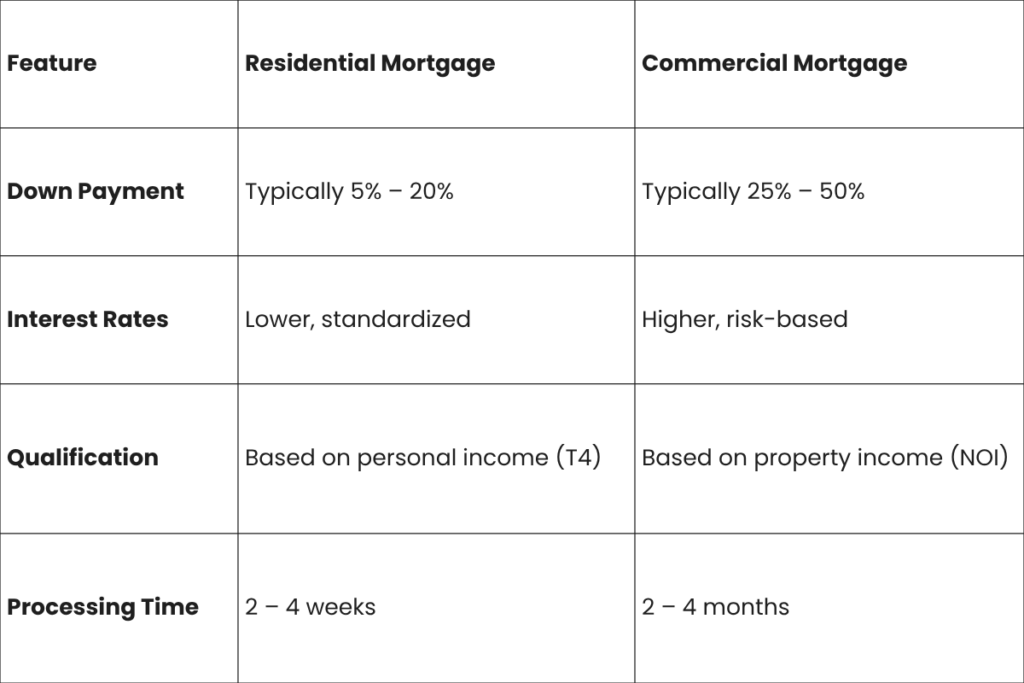
Choosing between the two depends on the property type. Use our mortgage comparison guide to find your best fit.
Common Mistakes Investors Make
- Underestimating Closing Costs: Commercial deals involve appraisals, environmental audits (Phase I and II), and specialized legal fees that can cost thousands before the deal even closes.
- Ignoring Vacancy Allowances: Investors often project 100% occupancy. Lenders will always “stress test” the numbers with a 5% or 10% vacancy factor.
- Choosing the Wrong Property Type: Buying a “niche” property without having a specialized lender lined up can lead to a rejected application.
How Mortgage Intelligence Helps You Finance Commercial Properties
Navigating the commercial mortgage property types and their specific requirements is a daunting task to do alone. At Mortgage Intelligence, we act as your strategic partner.
- Access to a Vast Network: We connect you with “A” lenders, credit unions, and alternative lenders that specialize in specific asset classes.
- Tailored Solutions: Whether you need mortgage refinancing options for an existing portfolio or a bridge loan for a new acquisition, we customize the terms.
- Expert Guidance: We help you package your application to highlight the property’s strengths, ensuring you get the best possible purchase rate.
Start your commercial mortgage journey with a team that understands the Canadian market inside and out.
Securing a commercial mortgage in Canada is not a “one-size-fits-all” process. A 50-unit apartment building in Toronto is a completely different risk profile than a manufacturing plant in Calgary. Understanding the eligibility for commercial loans in Canada is the first step toward building a resilient, income-producing portfolio.
Don’t leave your financing to chance. Expert guidance can save you time, reduce your stress, and most importantly, save you thousands in interest and fees.
FAQs
What types of properties qualify for commercial mortgages in Canada?
Broadly, any property used for business or income generation. This includes multi-family residential (5+ units), retail, office, industrial, hospitality, and special-purpose buildings like medical clinics or warehouses.
Is a 4-unit property considered commercial?
No. In Canada, properties with 1 to 4 units are generally classified as residential. However, if the 4-unit property has a commercial storefront (mixed-use), it may require a commercial mortgage.
Can I get a commercial mortgage for a mixed-use property in Canada?
Yes. Mixed-use properties are very common. Lenders will evaluate the ratio of residential to commercial square footage and income to determine the specific loan terms.
For commercial real estate, what is the required minimum down payment?
While some CMHC-insured multi-family loans allow for lower down payments, most conventional commercial mortgages require a minimum of 25% to 35% down. High-risk properties (like hotels) may require 50%.
Are commercial mortgages harder to qualify for?
They aren’t necessarily “harder,” but they are “different.” They require significantly more documentation, including environmental reports, rent rolls, and detailed financial statements for the property itself.
Can I live in a commercial property?
You can live in a “mixed-use” property (e.g., the apartment above your store), but you cannot typically get a commercial mortgage for a property that is strictly your personal residence.