
Many buyers start browsing listings before they know what they can actually afford. It feels exciting at first, but it can quickly lead to disappointment, wasted time, and missed opportunities.
A mortgage pre-approval helps you understand your purchasing power before you begin your search. It gives you a clearer idea of your potential price range, monthly payment comfort level, and the type of mortgage you may qualify for. It can also help you identify issues early, such as debt levels, credit concerns, income documentation gaps, or down payment limitations.
Whether you are a first-time buyer, move-up buyer, investor, newcomer, or self-employed borrower, getting a mortgage pre-approval Canada buyers can rely on should be one of your first steps. It helps you shop with confidence instead of guessing.
Before starting your home search, you can get mortgage pre-approved before house hunting with support from Mortgage Intelligence.
What Is a Mortgage Pre-Approval?
A mortgage pre-approval is when a lender reviews your financial situation and estimates how much they may be willing to lend you. During this stage, the lender usually looks at your income, employment, credit history, debts, down payment, and supporting documents.
The Financial Consumer Agency of Canada explains that during pre-approval, a lender reviews your finances to estimate the maximum amount they may lend, the potential interest rate, and may also run a credit check.
Pre-Approval vs. Mortgage Approval
Pre-approval happens before you buy and is based on your current financial profile. Final approval occurs after an accepted offer, when the lender reviews the property, purchase agreement, and any conditions. Pre-approval helps you shop confidently but does not guarantee financing.
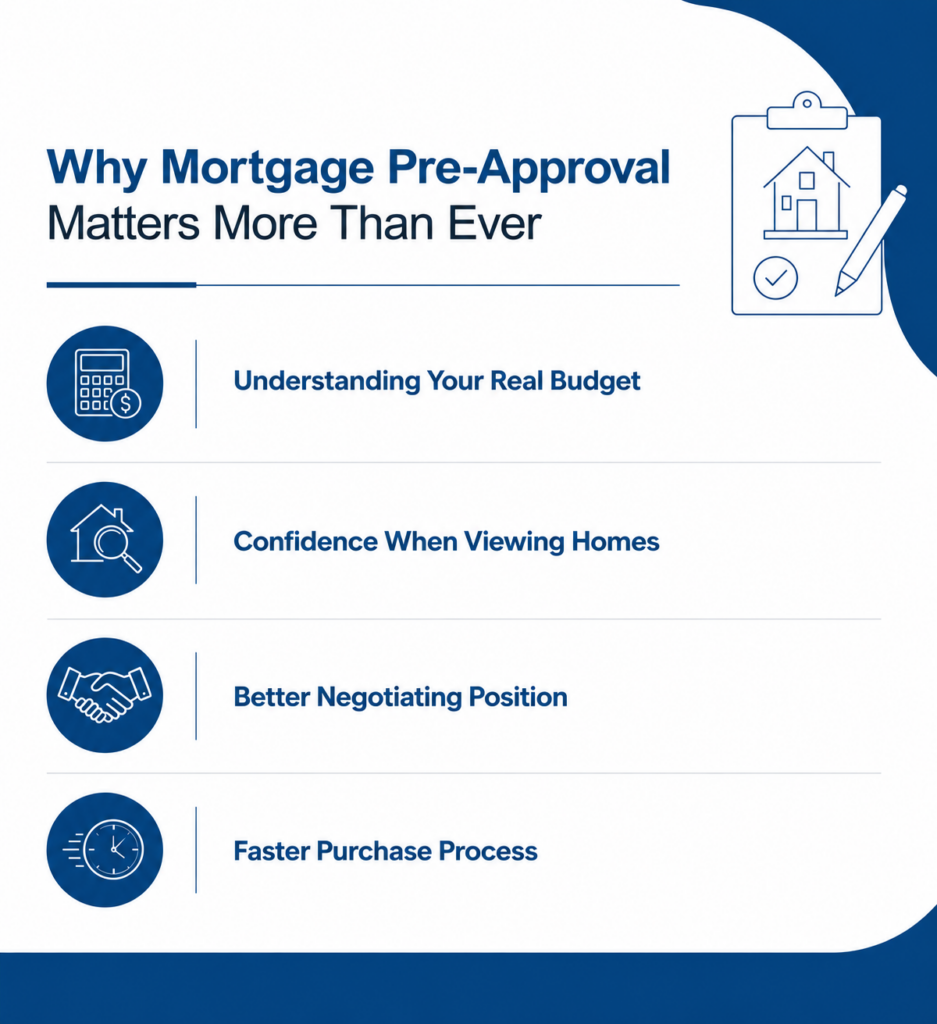
Understanding Your Real Budget
One of the biggest benefits of mortgage pre-approval is clarity. Instead of guessing based on online listings or rough calculators, you get a more realistic idea of what you may qualify for.
This is especially important in Canada, where affordability depends on income, debt, down payment, interest rates, property taxes, heating costs, condo fees if applicable, and the mortgage stress test.
If you are asking, “How much mortgage can I qualify for?” pre-approval is the best place to start. You can also use financial tools we offer to support your mortgage decision to estimate affordability before speaking with a broker.
Confidence When Viewing Homes
House hunting becomes easier when you know your range. You can focus on homes that match your budget instead of spending time on properties that may not fit your financing.
This helps you compare neighbourhoods, property types, and monthly costs more realistically. It also helps your real estate representative guide you toward homes that make sense for your situation.
Better Negotiating Position
Sellers often take buyers more seriously when they have already started the financing process. A pre-approval shows that you have taken the time to review your finances and are prepared to move forward.
It may not make your offer unconditional, but it can make your offer appear stronger than one from a buyer who has not spoken with a lender or broker yet.
Faster Purchase Process
When you already have your documents ready, the purchase process can move more smoothly after your offer is accepted. Your broker can update the file, submit property details, and help work through conditions faster.
For a helpful overview of the broader home financing path, Mortgage Intelligence’s guide on how to begin your mortgage journey explains how buyers can prepare with more confidence.
How Pre-Approval Helps Different Types of Buyers
First-Time Home Buyers
A first-time home buyer pre-approval is especially helpful because many first-time buyers are learning the process for the first time. Pre-approval can explain what price range is realistic, how much down payment may be needed, and what monthly costs may look like.
First-time buyers may also need guidance on mortgage insurance, closing costs, land transfer tax, and available programs. Mortgage loan insurance is typically required when the down payment is less than 20% of the purchase price.
If this is your first purchase, check out first-time home buyer mortgage solutions and guidance.
Move-Up Buyers
Move-up buyers often need to coordinate selling one home and buying another. Pre-approval helps estimate how much they may qualify for based on current income, existing mortgage balance, home equity, bridge financing needs, and future payments.
It also helps buyers understand whether they should sell first, buy first, or prepare for both scenarios.
Real Estate Investors
Investors are evaluated differently because lenders look at rental income, existing mortgage obligations, property expenses, and overall debt load. A pre-approval helps investors understand whether another property fits their financial profile.
It can also help compare rental property financing options before making an offer.
Self-Employed Borrowers
Self-employed buyers may need extra documentation to prove income. This can include tax returns, notices of assessment, business financial statements, bank statements, contracts, or proof of business activity.
Starting early is important because the lender may calculate income differently than the borrower expects.
Newcomers to Canada
Newcomers may have high income but limited Canadian credit history. Pre-approval can help identify what lenders need, whether alternative credit documents may help, and how much down payment may be required.
This early review can prevent surprises when the buyer is ready to make an offer.
What Lenders Evaluate During Pre-Approval
Income Verification
Income is one of the most important requirements for mortgage pre-approval. Lenders want to confirm that your income is stable, reliable, and enough to support the mortgage payment.
For employees, this may include pay stubs, employment letters, T4 slips, or tax documents. For self-employed borrowers, the process may involve more detailed income review.
Employment Stability
Lenders may look at how long you have been in your role, whether you are full-time, part-time, contract, seasonal, commissioned, or self-employed. A recent job change does not always prevent approval, but it can affect what documents are needed.
Credit Score and Credit History
What is the role of credit score in securing purchase mortgages? Your credit score is a key factor lenders use to assess your ability to repay a mortgage. A higher score can improve your chances of approval, help you qualify for better interest rates, and increase the mortgage amount you may be offered. Conversely, a lower score may limit your options or require additional documentation to demonstrate financial stability.
Lenders review your payment history, credit limits, balances, missed payments, collections, and overall credit usage before a mortgage approval.
Existing Debt Obligations
Car loans, credit cards, student loans, lines of credit, personal loans, and other debts can reduce the mortgage amount you qualify for. Even if the monthly payment feels manageable to you, lenders must include those payments in affordability calculations.
Down Payment Availability
Your down payment affects the mortgage amount, insurance requirements, and overall affordability. In Canada, the minimum down payment is generally 5% for homes up to $500,000, 5% on the first $500,000 and 10% on the portion above $500,000, and homes purchased with less than 20% down typically require mortgage loan insurance.
The federal government increased the insured mortgage price cap to $1.5 million effective December 15, 2024.
Debt Service Ratios
Lenders use two key ratios to see if you can afford a mortgage: Gross Debt Service (GDS) and Total Debt Service (TDS). GDS measures the portion of your income that goes toward housing costs, including mortgage payments, property taxes, and heating, while TDS includes all other debts like car loans and credit cards. The Canada Mortgage and Housing Corporation (CMHC) generally recommends keeping GDS below 39% and TDS below 44%, helping ensure you’re not overextended and can comfortably manage your mortgage.
Documents Typically Required for Mortgage Pre-Approval
Employment Income Documents
Common mortgage pre-approval documents for employees may include:
- Recent pay stubs
- Employment letter
- T4 slips
- Notice of assessment
- Proof of bonuses, overtime, or commission if applicable
Self-Employment Documentation
Self-employed borrowers may need:
- T1 Generals
- Notices of assessment
- Business financial statements
- Articles of incorporation if incorporated
- Bank statements
- GST/HST returns if applicable
- Contracts or invoices
Down Payment Verification
Lenders usually want to confirm where your down payment is coming from. This may include savings, investments, proceeds from a home sale, or a financial gift from an eligible family member.
Government Identification
You will usually need valid government-issued identification to verify your identity.
Existing Property Information
If you already own property, you may need to provide your current mortgage statement, property tax bill, lease agreements if rental income applies, and details about condo fees if applicable.
Step-by-Step: How to Get Pre-Approved
Step 1: Assess Your Financial Situation
Before applying, review your income, monthly expenses, debt, credit cards, savings, and down payment. This helps you understand whether you are financially ready and what areas may need improvement.
Step 2: Gather Documentation
Collect your employment letters, pay stubs, bank statements, and the past two years of CRA Notices of Assessment to build a complete application package.
Step 3: Speak With a Mortgage Broker
A mortgage broker can review your situation, compare lender options, and explain what may work best for your goals. This is especially helpful if you are self-employed, buying your first home, carrying debt, or unsure how lenders will view your income.
You can also review helpful mortgage broker questions before choosing who to work with.
Step 4: Submit Your Application
The application usually includes personal details, income, assets, debts, employment information, and consent for a credit check.
Step 5: Review Your Pre-Approval Terms
Once reviewed, you may receive an estimated mortgage amount, interest rate, payment estimate, term options, and conditions. Some lenders may also offer a rate hold. Rate hold periods vary by lender, but some major lenders advertise up to 120 days.
Step 6: Begin House Hunting
Once you understand your budget, you can shop more confidently. Mortgage Intelligence’s mortgage process guide can help you understand what happens from the first conversation to closing.
Common Reasons Buyers Get Less Than Expected
High Debt Levels
Debt can reduce borrowing power. Credit cards, car loans, lines of credit, and personal loans may lower the mortgage amount available.
Credit Challenges
Late payments, high balances, collections, or limited credit history can affect lender options. Some buyers may still qualify, but they may need a different strategy.
Income Limitations
Your income may be high, but lenders may not count all of it. For example, bonuses, overtime, commission, contract income, or self-employment income may need a longer history.
Inadequate Down Payment
A smaller down payment can limit price range and may require mortgage insurance. Buyers also need to show they have enough funds for closing costs.
Stress Test Qualification Requirements
Most borrowers must qualify at a rate higher than their actual contract rate. For uninsured mortgages, OSFI’s current minimum qualifying rate is the greater of the mortgage contract rate plus 2% or 5.25%.
This can reduce the amount a buyer qualifies for, even when they feel comfortable with the actual payment.
How to Improve Your Pre-Approval Results
If your initial qualification numbers do not meet your expectations, you can take practical, deliberate steps to strengthen your financial profile and increase your purchasing power. To optimize your strategy from day one, look into these tips for first-time residential mortgage applicants.
Reduce Existing Debt
Paying down credit cards, personal loans, or lines of credit may improve your debt ratios. Even reducing revolving balances can help strengthen your application.
Improve Your Credit Score
Make payments on time, avoid maxing out credit cards, and do not apply for unnecessary new credit before buying.
Increase Your Down Payment
A larger down payment can reduce the mortgage amount, lower risk, and improve affordability. It may also help you avoid mortgage insurance if you reach 20% down.
Avoid Major Financial Changes
Before and during pre-approval, avoid taking on new loans, financing a vehicle, changing jobs without advice, or moving large sums of money without documentation.
Work With a Mortgage Broker Early
Partnering with a dedicated mortgage broker well before you start looking at properties allows you to map out a clear plan. A broker can analyze your finances, identify specific areas that need improvement, and guide you through targeted steps to maximize your lending potential.
Mistakes Buyers Make During the Pre-Approval Process
- Shopping Before Getting Pre-Approved: Looking at homes before reviewing financing can lead to unrealistic expectations. Pre-approval helps you focus your search.
- Applying With Multiple Lenders Without Guidance: Multiple applications can create confusion and may lead to repeated credit checks. A broker can help compare options more efficiently.
- Taking on New Debt: New debt can change your qualification amount. Even a new car payment can reduce your mortgage affordability.
- Changing Jobs During the Process: Changing jobs is not always a problem, but it may create more documentation requirements, especially if your new role has probation, variable income, or a different pay structure.
- Ignoring Conditions Attached to the Pre-Approval: A pre-approval may include conditions. These can involve updated income documents, down payment proof, property review, appraisal, or final lender approval.
How Long Does a Mortgage Pre-Approval Last?
Many pre-approvals include a rate hold for a specific period. Some lenders offer up to 120 days, but this varies by lender and product.
You may need to renew your pre-approval if your rate hold expires, your income changes, your debt changes, your down payment changes, or you pause your home search.
If rates rise during your rate hold period, you may be protected based on the terms of the lender’s offer. If rates drop, your broker can help review whether a better option is available before final approval.
What Happens After You Get Pre-Approved?
Once you receive your pre-approval, you can confidently focus your home search on properties within your budget. Knowing your approved mortgage amount helps you avoid unrealistic listings and lets you prioritize homes that fit your financial capacity.
Remember, just because a lender approves a maximum loan does not mean you need to spend it all; you should consider your lifestyle, savings goals, and other expenses to choose a comfortable monthly payment. It’s also important to plan for closing costs, which typically range from 1.5% to 4% of the purchase price and include land transfer taxes, legal fees, title insurance, and property adjustments, so you can budget accurately for the final steps of your purchase.
Why Working With a Mortgage Broker Improves the Process
Access to Multiple Lenders
A mortgage broker can help you compare options from different lenders instead of relying on one bank. This can be useful when your income, credit, down payment, or property type needs a more tailored approach.
Better Rate Shopping
Rate matters, but the lowest rate is not always the best mortgage. Prepayment privileges, penalties, portability, fixed vs variable options, and lender flexibility all matter.
You can compare mortgage rates before making an offer to understand what may be available.
Identifying Qualification Opportunities
A broker can help structure your application properly. This may involve using the right income documents, reviewing debt repayment options, explaining down payment sources, or matching you with lenders that fit your profile.
Guidance Throughout the Purchase Journey
The right support can make the process easier from pre-approval to closing. A broker can help explain the terms, conditions, documents, and timing so you know what to expect.
How Mortgage Intelligence Helps Buyers Get Pre-Approved Faster
Personalized Mortgage Assessments
Mortgage Intelligence helps buyers understand where they stand before they start shopping. This includes reviewing income, debt, down payment, credit, and overall affordability.
Access to Multiple Lending Options
Different buyers need different solutions. Mortgage Intelligence can help you explore mortgage options available to Canadian buyers based on your goals and financial profile.
Support for First-Time Buyers, Investors, and Self-Employed Borrowers
Whether you are buying your first condo, moving into a larger home, purchasing an investment property, or applying with self-employed income, the right guidance can help you prepare a stronger application.
Clear Guidance From Application to Closing
Mortgage Intelligence can help you understand your options, prepare your documents, compare rates, and move through the financing process with more confidence. You can also connect with a mortgage broker near you when you are ready to begin.
Pre-approval is one of the smartest financial steps a homebuyer can take before entering the market. It helps you understand your budget, prepare your documents, identify potential issues, and shop with more confidence.
It also gives you a clearer path forward. Instead of wondering whether a home is affordable, you can focus on properties that match your financial situation and long-term goals.
If you are planning to buy a home, explore Mortgage Intelligence for personalized pre-approval guidance, mortgage options, rate comparisons, and support from a broker who can help you move forward with confidence.
Find a Mortgage Broker
FAQs
- What is a mortgage pre-approval?
A mortgage pre-approval is when a lender reviews your financial situation and estimates how much they may be willing to lend you. It may also include a rate hold for a specific period, depending on the lender.
- How long does mortgage pre-approval last in Canada?
Many pre-approvals last around 90 to 120 days, but this depends on the lender and mortgage product. Some lenders advertise rate holds of up to 120 days.
- Does a pre-approval guarantee mortgage approval?
No. A pre-approval does not guarantee final mortgage approval. Final approval depends on the property, accepted offer, appraisal if required, updated documents, and lender conditions.
- What documents are needed for pre-approval?
Common documents include pay stubs, employment letters, tax documents, down payment proof, government ID, and information about existing debts or properties. Self-employed borrowers may need additional documents.
- Does pre-approval affect my credit score?
A lender may run a credit check during pre-approval. This can appear on your credit report. The effect depends on your overall credit profile and the type of inquiry.
- How much can I get pre-approved for?
The amount depends on your income, debts, credit history, down payment, interest rate, property costs, and lender guidelines. A broker can help calculate a realistic range.
- Should I get pre-approved before viewing homes?
Yes. Getting pre-approved before viewing homes helps you understand your budget, avoid unrealistic price ranges, and make stronger decisions when you find a property you like.
- Can self-employed borrowers get pre-approved for a mortgage?
Yes. Self-employed borrowers can get pre-approved, but they may need more detailed income documents. Starting early helps identify what lenders require before making an offer.