
Debt can be difficult to manage when several accounts have different rates and payment dates. For homeowners with sufficient equity and a stable income, a refinance to consolidate debt may combine multiple obligations into a single mortgage payment.
Statistics Canada reported that household credit market debt reached 179.6% of disposable income in the first quarter of 2026; about $1.80 for every dollar earned.
Mortgage refinancing may reduce interest costs and improve cash flow, but it moves selected balances into debt secured by your home. A longer repayment period may also increase total interest. The best debt consolidation strategy in Canada considers affordability, total cost, and future spending habits.
This guide explains the process, lender requirements, costs, and risks while helping you plan how to secure financing responsibly.
What Does It Mean to Refinance Your Mortgage?
Mortgage refinancing means replacing your current mortgage with a new mortgage agreement. The new loan may have a different balance, interest rate, term, payment schedule, or amortization period. If the new principal exceeds the amount required to pay off the existing mortgage, the additional funds may be used for an approved purpose, such as debt consolidation.
Refinancing is different from a mortgage renewal. A renewal generally continues the remaining balance when the existing term ends. A refinance changes the financing arrangement; it may occur during a term or at renewal and normally requires a new application, updated qualification and legal registration.
Refinancing may make sense when you have sufficient equity, reliable income and debts that cost more than the proposed mortgage financing. It may also be considered when your current mortgage no longer fits your financial plan. An overview of mortgage refinancing can help you understand the common reasons homeowners consider this option.

What is Debt Consolidation?
Debt consolidation combines several balances into one credit product. A homeowner might use it to consolidate credit card debt together with other eligible obligations, such as:
- Personal loans;
- Unsecured lines of credit;
- Car loans;
- Retail financing; and
- Payday loans, where applicable.
The practical advantage is a single payment and a single repayment schedule. The financial advantage depends on the new rate, fees, and repayment period. A smaller monthly payment is helpful for cash flow, but it is not proof that the new loan costs less overall.
Consolidation should also be paired with credit-improvement habits: paying bills on time, keeping revolving balances under control, and reviewing credit reports for errors. Without those changes, paid-off credit accounts may fill up again while the larger mortgage remains.
How Mortgage Refinancing Can Consolidate Debt
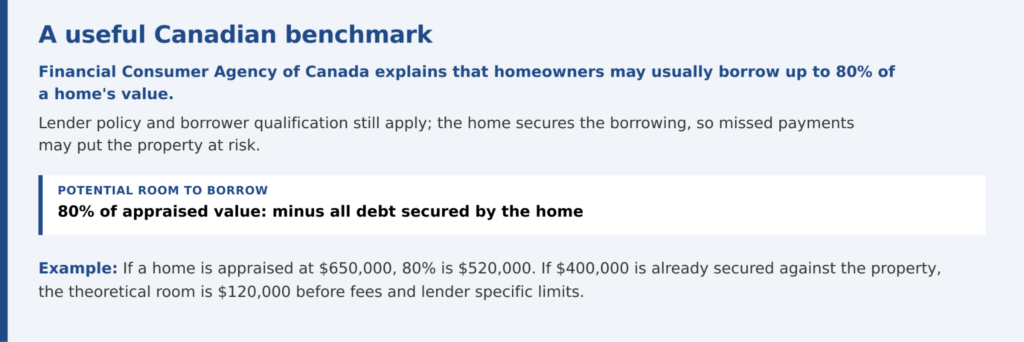
A home equity refinance uses a portion of the value you have built in your property. Home equity is the appraised value of the home minus the mortgage balance and any other debt secured against the property.
The basic process is straightforward:
- Determine available equity: by estimating the property’s current value and subtracting the mortgage, HELOC, and any other registered loans.
- Calculate the debts to be repaid: record each balance, interest rate, minimum payment, and any payout charge.
- Apply for refinancing: provide the requested income, credit, property, and debt documents. A mortgage pre-approval resource can help you understand the type of financial information commonly reviewed, although a refinance requires its own approval.
- Use the proceeds to clear approved balances: at closing, the lawyer, notary or lender may pay creditors directly. Confirm that every intended balance reaches zero.
- Begin the new repayment plan: make the mortgage payment on schedule and direct any planned extra amount toward principal within the mortgage’s prepayment privileges.
A search for mortgage refinance options in Canada may yield different products and qualification standards. Compare more than the advertised rate: review the total mortgage amount, amortization, payment, one-time costs, and total interest for the debt consolidation portion.
Benefits of Using a Refinance to Consolidate Debt
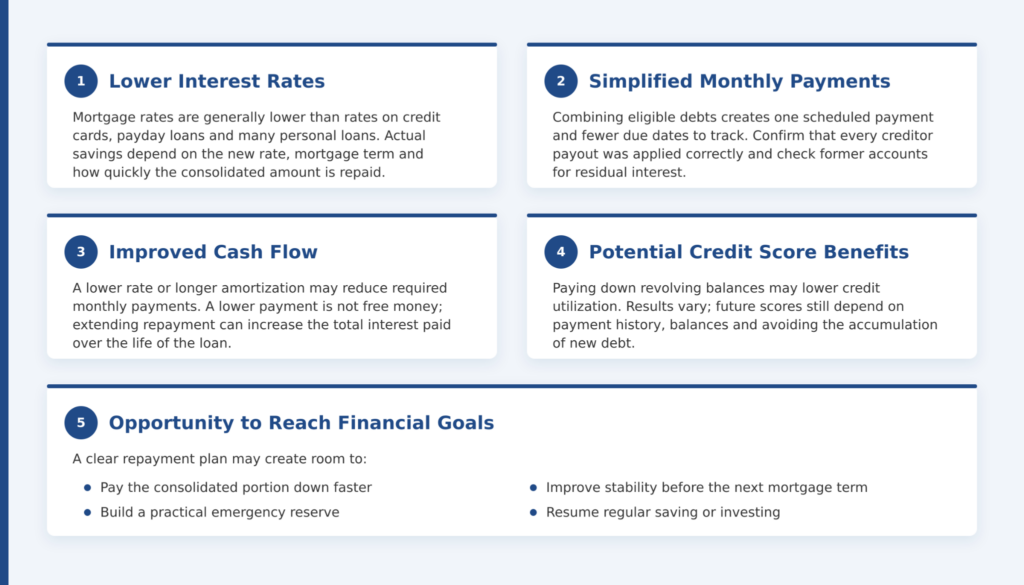
The main benefits of mortgage refinancing include a simpler repayment structure and greater control over the household budget. Combining eligible balances into the mortgage can reduce the number of payment dates to track and create a clearer path for paying down debt. However, the decision should be based on the complete financial picture, including fees, repayment length, and long-term costs.
Requirements to Refinance Your Mortgage in Canada
Approval is not based on equity alone. Homeowners reviewing mortgage refinance requirements in Canada should expect the lender to assess both the borrower and the property. For most home equity financing applications, requirements commonly include:
- Sufficient equity: the proposed mortgage and other secured loans must remain within the lender’s permitted loan-to-value limit;
- Income verification: recent pay information, tax documents, account statements or business records may be requested;
- Credit history: the lender reviews repayment behaviour, current balances and recent credit activity;
- Debt service ratios: housing costs and other monthly obligations are compared with gross household income;
- Mortgage stress test: borrowers may need to show they can afford payments at the applicable qualifying rate;
- Property appraisal: an independent valuation may be required to confirm market value; and
- Lender criteria: property type, location, mortgage amount and documentation standards vary.
Preparation matters because missing or inconsistent documents can slow the review. The guide “Why pre-approval matters and how to get it” offers a useful foundation for organizing income, debt, and credit information before a financing conversation.
Income documentation is not identical for every applicant. Business owners and contractors can review options for self-employed mortgages. Borrowers establishing their financial profile after moving to Canada can explore guidance for newcomers to Canada.
Costs to Consider Before Refinancing
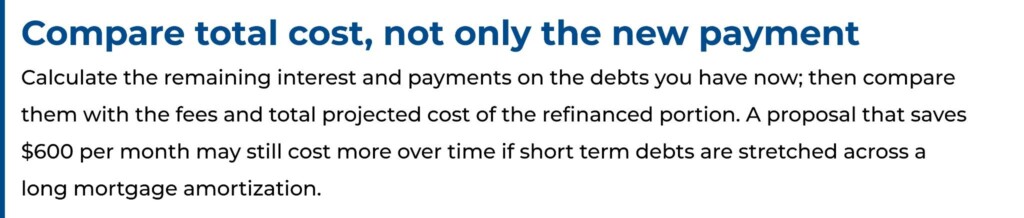
A lower interest rate does not automatically make a refinance home loan worthwhile. Ask for a written estimate and compare the projected savings with every cost, including:
- A mortgage prepayment penalty if the current contract is broken before maturity;
- Property appraisal fees;
- Legal or notary fees;
- Title search, title insurance and registration costs;
- Mortgage discharge and lender administration fees;
- A new mortgage loan insurance premium if applicable; and
- Additional interest created by extending the amortization.
Timing can make a material difference. If renewal is approaching, waiting may reduce or eliminate a mortgage break penalty. If rates, debts or property plans are changing, review several scenarios before signing.
When Refinancing May Not Be the Best Option
A refinance may not be suitable when:
- The property has limited usable equity;
- The mortgage break penalty and closing costs outweigh the likely savings;
- Only a short period remains before renewal;
- Income is unstable, or the proposed payment is difficult to afford under the qualifying rate;
- The current mortgage rate is much lower than the rate available on a larger new balance;
- The household is likely to use the paid-off credit again; or
- The debt is already unmanageable, and a formal debt relief assessment is more appropriate.
Alternatives may include a personal consolidation loan, a Home Equity Line of Credit (HELOC) with a fixed repayment plan, a refinance timed for renewal, credit counselling or advice from a Licensed Insolvency Trustee. Each choice has different costs and consequences.
Borrowers who do not qualify with a traditional lender sometimes consider alternative financing. Review the risks and benefits of using private lenders in Canada carefully: rates, fees, terms and exit requirements may be less favourable. Homeowners aged 55 or older may also hear about reverse mortgages; this is a distinct product with accumulating interest and should not be treated as an automatic substitute for refinancing.
Tips to Maximize the Benefits of Debt Consolidation
- Prevent new debt: reduce unnecessary credit limits, remove stored card details and stop using accounts that undermine the plan.
- Build an emergency fund: even a modest reserve can reduce the need to use credit for the next unexpected expense.
- Create a realistic budget: include irregular expenses such as repairs, insurance and annual fees.
- Keep repayment momentum: if the new required payment is lower, consider directing part of the difference to principal within permitted prepayment limits.
- Track the consolidated portion: set a target date to pay it off rather than allowing it to remain through the full mortgage amortization.
- Review goals regularly: check the budget, balances and progress at least once a year and before each renewal.
- Compare lenders and structures: an experienced mortgage professional can evaluate rates, penalties, features and qualification rules across available options.
A responsible refinance mortgage for a debt plan should also protect future choices. Before using all available equity, consider whether the household expects to move, build, buy another property or invest. These resources can support that wider planning:
Before using all your available equity, think about your future housing plans. If you are deciding between Building vs. Buying a Home in Canada, consider how refinancing today could affect your budget for that next step.
If you expect to move, understanding Next Home Mortgages can help you determine how much equity to preserve for a future down payment and related purchasing costs.
Your longer-term goals also matter. Buying a Vacation Property, purchasing an Investment Property, or applying for a Commercial Mortgage may require additional funds and borrowing capacity, so avoid taking out more equity than you currently need.
Frequently Asked Questions
1. Can I refinance my mortgage to pay off credit card debt?
Yes, if you have enough usable equity and qualify for the new mortgage. The approved refinance proceeds can be used to pay selected credit card balances, often through direct payouts at closing. Remember that the debt becomes secured by your home.
2. How much equity do I need to refinance my home?
Home equity borrowing is commonly limited to 80% of the appraised property value. In practical terms, at least 20% must usually remain in the property after the refinance; lender policy may require more. Subtract the current mortgage and every other loan secured against the home to estimate the available amount.
3. Will refinancing affect my credit score?
It may. The application can create a credit inquiry, and the new mortgage changes your credit file. Paying off revolving balances may improve your credit utilization, but the long-term outcome depends on making consistent payments and avoiding new debt.
4. Is refinancing better than a debt consolidation loan?
Not in every case. Refinancing may offer a lower rate and a larger amount, but it uses the home as collateral and may include penalties, legal costs, and a longer repayment period. An unsecured consolidation loan may cost more in interest but does not place a mortgage charge on the property. Compare total cost, payment, and risk.
5. How long does mortgage refinancing take in Canada?
There is no single standard timeline. The process may take several weeks depending on document readiness, appraisal scheduling, lender review, title work and closing requirements. Complex income, credit or property files may take longer.
6. Can I refinance if I have bad credit?
It may be possible, but the choice of lenders, rate and permitted loan-to-value can be less favourable. A larger equity position, stable income and a clear explanation for past issues may help. Compare the cost of proceeding now with the potential benefit of improving credit first.