
Deciding between a fixed or variable mortgage rate is a major financial choice for any Canadian homebuyer. It doesn’t just impact your monthly payments. It affects the total amount of interest you’ll pay, how flexible your finances are, and your overall peace of mind. Whether you’re buying your first home, refinancing, or eyeing a real estate investment, understanding how each option works and how it fits with today’s economy is key to making a smart move.
Why the Fixed vs. Variable Decision Matters
Mortgage rates in Canada don’t exist in a vacuum. They’re shaped by the Bank of Canada’s key interest rate, inflation, and lender decisions. So, picking between fixed and variable rates has real consequences for:
- Your monthly spending
- Total interest paid over time
- How well you can handle changes in rates
- Your ability to refinance or make early payments
Knowing how each option works helps you avoid future financial stress and line up your mortgage strategy with both your short-term and long-term plans.
What Is a Fixed-Rate Mortgage?
With a fixed-rate mortgage, your interest rate stays the same for the entire term. That means your payments won’t go up or down, no matter what happens in the market.
Pros:
- Budget-Friendly: Great if you want predictable payments.
- Rate-Proof: You’re protected if interest rates rise.
- Set It and Forget It: No need to watch rate changes or adjust your budget.
Cons:
- Higher Starting Rate: Usually a bit more expensive than variable at the beginning.
- Penalty Risk: Breaking the mortgage early can come with steep fees.
- Less Wiggle Room: Not ideal if you think you’ll move, sell, or refinance before your term ends.
What Is a Variable-Rate Mortgage?
Variable mortgages move with the lender’s prime rate, which is tied to decisions from the Bank of Canada. Your payments might change if interest rates go up or down.
Pros:
- Lower entry rate: Typically starts at a cheaper rate than a fixed-rate mortgage.
- Room to save: If rates go down, you’ll pay less interest.
- Short-term advantage: Works well if you plan to move or refinance soon.
Cons:
- Unpredictable payments: Your monthly amount could rise, making budgeting harder.
- Less certainty: Higher rates mean higher costs over time.
- Tougher to qualify: You’ll need to pass a higher stress test.
Comparing the Two: Key Differences
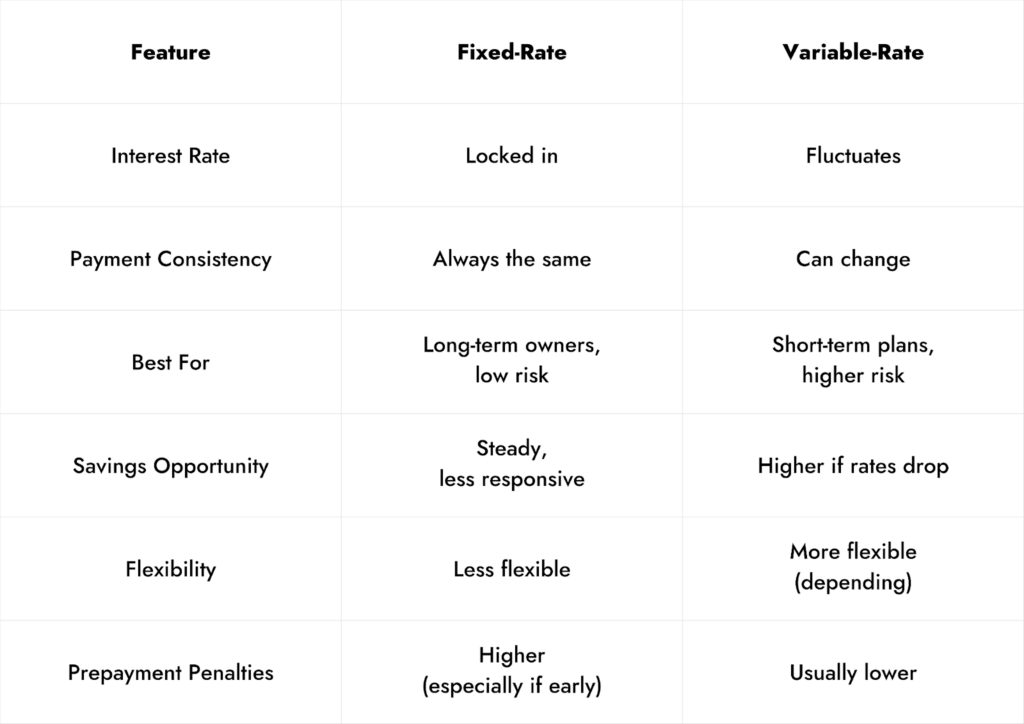
Here are important elements to consider:
Stability or Potential Savings. What Matters Most to You?
- For budgeting and preventing financial surprises, fixed-rate mortgages provide steady, predictable payments over the course of the loan.
- Variable-rate mortgages may save you money if interest rates decline because they usually start with lower rates. However, if the Bank of Canada raises its rates, your payments may go up.
How Much Risk Can You Handle?
- If you have strict financial obligations or prefer budgeting certainty, a fixed rate is best.
- If you are more financially flexible and have a greater risk tolerance, a variable rate is usually preferable.
Think About Your Future Plans
- A fixed rate offers security if you intend to remain in your house for the duration of the mortgage.
- A variable rate gives you more flexibility if you plan to move, refinance, or pay off your mortgage early.
What About Penalties?
- Higher penalties for early mortgage termination are frequently associated with fixed mortgages.
- If your plans change, you have more options with variable mortgages because they typically have lower penalties.
What Kind of Buyer Are You?
Here are a few example scenarios to help narrow things down:
- First-Time Buyer: Budget-Conscious
Pick: Fixed Rate
Why: You’ll appreciate the predictable monthly costs and peace of mind.
- Young Professional: Planning to Move
Pick: Variable Rate
Why: If you’re only staying 3-5 years, the lower starting rate can save you money.
- Seasoned Investor: Comfortable With Risk
Pick: Variable or Hybrid
Why: You may be able to take advantage of rate dips for bigger savings.
Interest Rate Trends and What They Mean
As of 2025, interest rates in Canada are beginning to level off after a period of aggressive hikes aimed at curbing inflation. Economists are predicting modest rate cuts by late 2025 or into 2026.
Here’s what that means for you:
- Rates Fall: Variable-rate borrowers could see significant savings.
- Rates Climb Again: Fixed-rate borrowers won’t feel the pinch, but variable-rate holders might.
So, take a look at the Bank of Canada’s outlook and advice from trusted Canadian financial sources when making your decision.
Quick Comparison: Fixed vs. Variable
Talk to a Professional Mortgage Broker
Every homebuyer’s situation is different, and there’s no one-size-fits-all answer. If you’re still unsure which mortgage option is best for you, speaking with a mortgage broker is a smart move. They’ll help break down your finances, explain current rate trends, and guide you toward a choice that could save you money and stress in the long run.
Ready for expert advice? Reach out to one of our experienced mortgage brokers today and make your next move with confidence.
FAQs
- What is the difference between a fixed and variable mortgage?
Fixed rates stay the same; variable rates change with the market. - Which mortgage type offers more payment stability?
Fixed-rate mortgages are more consistent month to month. - Are fixed rates always safer than variable?
Not necessarily; it depends on the economy and your comfort with uncertainty. - When is a variable-rate mortgage a better option?
If you plan to sell soon or expect rates to drop. - How do interest rate changes affect variable mortgages?
Your payments may go up, or your amortization might be adjusted by the lender. - What happens if I want to switch from variable to fixed?
Usually yes, but terms vary by lender. - Do fixed-rate mortgages have higher penalties?
Often, especially if you break your mortgage early. - Can I save money with a variable mortgage in the long run?
Possibly, especially if rates stay low or fall during your term. - How does my financial situation influence this choice?
If you’re on a tight or fixed income, a fixed rate might give you more breathing room. - Should first-time buyers choose fixed or variable rates?
Fixed is generally safer, but it depends on how comfortable you are with potential rate swings.