
For many homeowners, the ultimate stressor isn’t just finding the perfect new home; it is the logistical nightmare of aligning the sale of their current property with the purchase of the next one. Perhaps you have stumbled upon your dream home in a competitive neighbourhood, but your existing residence hasn’t even hit the market yet. Or, maybe you’ve accepted an offer, but the closing dates are weeks apart, leaving you short on the cash required for your new down payment.
These timing mismatches are incredibly common, but they don’t have to result in lost opportunities or rushed, undervalued sales. This is where interim financing in Canada homeowners rely on, comes into play. By utilizing bridge financing solutions, you can secure your next property with confidence, maintain financial flexibility, and move on your own terms. If you find yourself caught between two properties, speaking with a mortgage expert can help you determine if this strategic tool fits your specific situation.
What Is Interim (Bridge) Financing?
Interim financing, more commonly known as a bridge loan, is a specialized, short-term lending product designed to “bridge” the financial gap between the purchase of a new home and the finalized sale of an existing one. In essence, it allows you to access the equity in your current home to use as a down payment on the next one before the first sale’s funds are actually in your bank account.
Typically, short-term mortgage financing Canada lenders offer for these scenarios lasts anywhere from a few days to a maximum of 90 days. It is not intended to be a long-term debt solution but rather a temporary convenience to ensure a seamless transition between titles.
When Is Interim Financing a Good Option?
Deciding when to use a bridge loan depends largely on your timeline and the specific conditions of your local market. Here are the most frequent scenarios where interim financing becomes a viable, and often necessary, option.
You’ve Bought a New Home Before Selling Your Current One
In a “seller’s market,” many buyers prefer to secure their new residence first to avoid being left without a home. If you find the perfect property and your offer is accepted, you may need a significant sum for the down payment while your current equity is still locked in your primary residence.
Closing Dates Don’t Align
Even if you have sold your home, the “possession dates” rarely match up perfectly. If your new purchase closes on the 1st of the month, but your current sale doesn’t close until the 15th, you are effectively a homeowner of two properties for two weeks. Bridge financing covers the purchase price of the new home during that 14-day window.
You Want to Avoid a Quick or Discounted Sale
Pressure to sell quickly can lead to accepting lowball offers. By using interim financing, you remove the “desperation” factor. You have the breathing room to wait for the right buyer and the right price, rather than settling for a discounted sale just to meet a purchase deadline.
Competitive Market Conditions
In high-demand areas like the Greater Toronto Area or Vancouver, sellers often prioritize “unconditional” offers. Having your financing in place via a bridge loan allows you to act fast and employ strategies for securing the best purchase rate without making your offer contingent on a home sale that hasn’t happened yet.
How Interim Financing Works (Step-by-Step)
Understanding how bridge financing works involves a few specific steps that differ from a standard mortgage application.
Step 1: Confirm Sale of Existing Property
Most traditional Canadian lenders require a “firm” (unconditional) sale and purchase agreement for your current home before they will grant a bridge loan. This proves that the money to repay the loan is guaranteed to arrive by a specific date.
Step 2: Determine Required Loan Amount
Your broker will calculate the loan based on the expected net proceeds of your sale (sale price minus existing mortgage and real estate commissions). This amount is then applied toward the purchase of the new home.
Step 3: Secure Bridge Financing
The approval process for interim financing is generally faster than a standard mortgage because it is based on the equity of a sold property. However, it is still a distinct credit product that requires its own documentation.
Step 4: Use Funds for Down Payment or Purchase Completion
On the closing date of your new home, the lender advances the bridge loan funds to your lawyer. These funds are used to complete the purchase, allowing you to move in.
Step 5: Repay Loan Once Property Sells
When your old property finally closes, your lawyer receives the funds from the buyer. These funds are used first to pay off your old mortgage and then to immediately pay back the bridge loan (including interest and fees). Following a step-by-step guide to our mortgage process ensures you understand how these moving parts settle.
Costs Associated with Interim Financing
While bridge loans are incredibly helpful, they are not free. Because they represent a higher risk and a shorter term for the lender, the costs are higher than those of a standard long-term mortgage.
- Interest Rates: Expect to pay a higher rate, often Prime plus 2% or 3%. However, since the loan is only for a few weeks, the total interest paid is usually manageable.
- Administration Fees: Most lenders charge a flat fee for processing the bridge loan, typically ranging from $200 to $500.
- Legal Costs: Your lawyer will need to register the bridge loan and handle the discharge, which will add a few hundred dollars to your legal bill.
Preparation is key here; taking the time for understanding closing costs and additional fees can prevent “sticker shock” during the final week of your transaction.
Benefits of Interim Financing
Interim financing offers several benefits for borrowers, including:
- Quick Access to Funds: It provides immediate cash flow, allowing businesses to bridge financial gaps until permanent financing is secured.
- Flexible Terms: Often more flexible than traditional loans, interim financing can be tailored to meet specific short-term needs.
- Supports Ongoing Projects: Helps businesses continue operations or complete projects while waiting for long-term financing solutions.
- Minimized Disruption: Prevents delays in business plans or transactions, helping maintain momentum during the financing process.
It is particularly useful for those needing funds quickly, like in real estate development or business expansion.
Risks and Considerations
No financial product is without risk, and interim financing risks Canada residents should consider include:
Delays in Selling Your Property
If your sale falls through for any reason (e.g., the buyer’s financing fails), your bridge loan remains active. This can be dangerous as you are now responsible for two mortgages and a high-interest bridge loan simultaneously.
Carrying Two Properties Temporarily
Even if everything goes to plan, you must be financially prepared to cover the utilities, insurance, and maintenance for two homes during the “bridge” period. You should consult a professional about risk considerations for each mortgage type to ensure your cash flow can handle the overlap.
Interim Financing vs. Other Options
Is a bridge loan always the best choice? Sometimes, other temporary mortgage financing options might be more cost-effective.
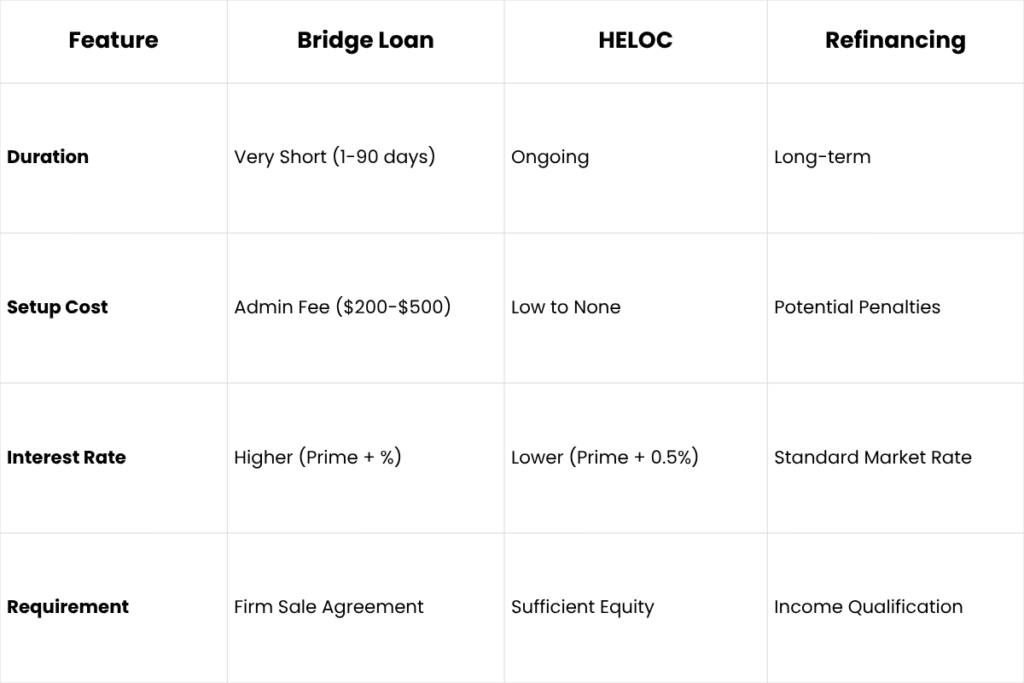
Bridge Loan vs. HELOC
If you already have a Home Equity Line of Credit (HELOC) on your current home, it might be cheaper to draw from that for your down payment. HELOC rates are often lower than bridge loan rates, and there are no administration fees.
Bridge Loan vs. Refinancing
Refinancing involves breaking your current mortgage to access equity. While this can provide a larger sum of money, it often comes with heavy prepayment penalties. Evaluating refinancing your mortgage for better terms versus a bridge loan is a calculation best done with a broker.
How Much Can You Borrow with Interim Financing?
Lenders in Canada typically allow you to borrow up to $200,000 to $500,000 for a bridge loan, though some specialized lenders can go higher. The amount is strictly limited by the equity in your home. For example, if your home is sold for $800,000 and you owe $400,000 on the mortgage, your maximum bridge loan would be $400,000 (minus commissions and fees).
Lenders also look at your debt-service ratios. Even though the loan is short-term, they must ensure you aren’t over-leveraged. Using a mortgage comparison guide to find the best option can help you visualize how these different debt loads impact your overall financial health.
Tips to Use Interim Financing Successfully
- Have a Firm Sale Agreement: Most “A” lenders will not bridge your loan without a firm offer. If you haven’t sold yet, you may need to look at private lenders, which are significantly more expensive.
- Plan Your Timeline: Try to keep the bridge period as short as possible. Even a difference of five days can save you hundreds in interest.
- Work with a Broker: Brokers have access to multiple lenders. If your current bank says no to a bridge loan, a broker can often find a solution elsewhere.
- Understand Your Budget: Ensure your financial goals influence your mortgage choice so that the short-term costs of bridging don’t derail your long-term savings.
Common Mistakes to Avoid
One of the most frequent mortgage mistakes brokers help you avoid is overestimating how quickly a sale will close. Real estate delays happen; always have a “Plan B” or a small emergency fund to cover an extra week of interest if the buyer’s lawyer is slow with the paperwork. Additionally, never assume your existing lender will automatically provide a bridge loan; always confirm this during your mortgage pre-approval before purchasing your next home.
How Mortgage Intelligence Helps You Navigate Bridge Financing
Navigating the transition between homes requires more than just a loan; it requires a strategy. At Mortgage Intelligence, we specialize in exploring flexible mortgage options for complex situations that traditional banks might find too “outside the box.”
Our network of experts provides:
- Access to Multiple Lenders: If one lender’s bridge fees are too high, we find a more competitive alternative.
- Fast Approvals: When you find a home you love, you don’t have time to wait weeks for an answer.
- Comprehensive Planning: We look at your refinancing options to access equity during transition periods to see if a bridge is truly your cheapest route.
Our brokers help you find the right mortgage rates and make your move as stress-free as possible.
Interim financing is a powerful tool in the Canadian homeowner’s arsenal. It transforms the “buy or sell first” dilemma from a source of anxiety into a strategic choice. While the costs are higher than a traditional mortgage, the flexibility to secure your desired property without a rushed sale is often worth every penny.
With careful planning and expert guidance, you can navigate the gap between your old front door and your new one with total confidence.
Ready to make your next move? Connect with a mortgage broker near you for guidance and discover bridge mortgage solutions for buying before selling to simplify your real estate journey.
FAQs
What is interim financing in Canada? It is a short-term loan (usually 1-90 days) used to cover the down payment and purchase costs of a new home before the sale of your current home closes.
How does a bridge loan work for buying a home? The lender advances you funds based on the equity in your current home. You use that money to close on your new home. When your old home sells, the proceeds go directly to paying off the bridge loan.
Do I need to sell my home before getting interim financing? Most lenders require a firm, unconditional sale agreement on your current home before they will approve a bridge loan. If you haven’t sold yet, you may need to seek a private lender.
What are the risks of bridge financing? The primary risk is your sale falling through. If the buyer backs out, you are left holding two mortgages and a high-interest bridge loan for much longer than anticipated.
How long does interim financing last? Most bridge loans are designed for a term of 90 days or less, though they can be as short as a single day.
Is interim financing expensive? The interest rates are higher than standard mortgages (typically Prime + 2% or 3%), and there are administrative fees. However, because the loan is only for a few days or weeks, the total dollar cost is usually a small fraction of the overall transaction.